Venice, June 18, 2011—
AN OLD GUY, apparently shakier than he looks, sits down on the bench to take off his shoes. There seems to be some problem with his shoelaces: he can't get them untied. Finally, with great effort, he pulls the still-tied shoes off his feet and stows them in the pigeonhole under the bench. He puts on one of the white cloth foot-covers provided, tries to open another for the other foot, fails, tosses it in the bin of dirty foot-covers, tries to open another, succeeds. Then he stands uncertainly in the unfamiliar shoe-covers and waits. Two people ahead of him are also waiting their turn to walk up a number of black-carpeted steps into a sort of theater at the back of which three other people gaze at a solid curtain of colored light.
It's a long wait, so he bends over, retrieves a shoe, and begins to pick at the knot in the shoelaces. He can't see what he's doing: the light is dim. He takes off his glasses, awkwardly holding them by biting one of the temples, and peers at the knot. He looks out at the sea of people waiting behind a barrier, being let in only three at a time. He seems a little embarrassed, and why not? I would be too.
The knot finally untied, the shoe back in its pigeonhole, he begins to pick at the other one, gives up, shelves it, and turns toward the waiting people. The attendant tells him he may join another couple in the theater. He steps uncertainly up the stairs, whose treads are two short for sure footing. The attendant warns him not to step too close to the light-curtain; there's a drop of several feet at the front end of the stage.
The colors seem a little grainy, gauzy, with imperfections floating across, but they are very beautiful: a constant allover intensity, imperceptibly changing through indigos, blues, deep reds. After only a couple of minutes, though, he turns to leave, weaving a bit as he approaches the steps. He motions to the attendant, who reaches out offering his hand to steady him on the way down.
Seated, he picks with irritation at the remaining shoelace, finally untying it. He puts on a shoe, begins to tie it, takes it off, removes the foot-cover and tosses it into the box, repeats the gesture with the other, puts on his shoes, manages to tie them in the dark, and walks out the exit, alone, and disappears.
That's the James Turrell installation at the Biennale. I consider Turrell with mixed emotions. His work with color and light is as pure and magical as possible, I think: but it requires a degree of focus and concentration on the part of the viewer that can only be achieved, apparently, through a great deal of audience manipulation and even more tightly determined isolation from other simultaneous experience. You have to deal with Turrell on his own terms. There's nothing inherently wrong with this, and it's far from unprecedented: Richard Wagner comes to mind. But I've never been comfortable with Wagner's demands, either.
(Speaking of Wagner, we toured La Fenice, the Venice opera house, the other day — an absorbing tour of a magnificent theater. The orchestra was on stage, rehearsing Das Rheingold, and we sat in the Royal Box for eight or ten minutes to listen. Yesterday on a vaporetto I was talking to a French woman; she said they were on their way to La Fenice for the tour. I told her about our experience, explaining that it was only an orchestra rehearsal, no singers. It's always better that way, she responded.)
The Biennale — well, it's a mess, as everyone is saying; but it's inevitable. Scores of countries have fielded hundreds of artists of varying degrees of skill and persuasiveness, most of them, to my taste and receptivity, unsuccessful. By far the majority seem to be concerned with the same problems the rest of us have on our minds: injustice, war, environmental problems, cruelty, and the like. Unlike the rest of us, they bring these concerns to work, make of them the subject of their art. To this degree they seem to me to be politicians, or propagandists, or social critics, rather than artists. Nothing wrong with politicians, propagandists, and social critics; we need them; they often improve the quality of life: but you don't go to them for insights into transcendent expressions of visual or sonic or even textual interest and beauty.
Final Cut Pro is apparently the acrylic paint of our time; a great many of these artists work in or with video, using found or stock imagery, or shooting their own, again for the most part in order to express reactions to prevailing social and political issues. I wrote the other day about having seen Passage, Shirin Neshat and Philip Glass's video of men, women, a girl, desert, death, and fire. I found it compelling: the majestic beauty of the sea and the desert, the colors, the fire all compelled visual response; the score, the rhythm of the direction and the gestures of the actors similarly rewarded the ear and one's sense of time; the theme — the inextricability of life and death in the rites of passage humans develop to confront their evanescence in the face of Nature — was just that, theme, not "message." It resonated with Quasimodo's marvelous poem, on my mind a lot during this Venice sojourn:
Ognuno sta solo sul cuore della terraIt's asking a lot of any artist to stand next to Quasimodo, or Turrell for that matter. One of these videos, when I happened on it, was displaying a scene from Hamlet: the actor — I'm ashamed I don't know who; I've never been much of a film buff, clearly an important and skillful actor — was delivering the "Alas, poor Yorick" soliloquy. It's brave to include Shakespeare in your video, I think, but foolhardy too.
Trafitto da un raggio di sole
Ed è subito sera.
(Each alone on the heart of earth / transfixed by a ray of the sun / and suddenly it's evening)
A lot has been said about the Italian pavilion; we can take it as representative of the entire Biennale. Literally hundreds of Italian artists were invited to participate, with a result reminding me of the "festivals" of "art" — photography, painting, sculpture, and other media — that used to be put on in outdoor venues by community organizations in the summertime. Or, the muses help us, of the exhibitions of amateur "art" at the county fair. There is good work here, and provocative commentary: but it tends to get lost in the jumble. And you can complain that the curator doesn't show a lot of respect for the art in the casual means employed to hang it: but perhaps respect itself is a red herring.
RIDING AROUND ON BOATS in the constantly changing Venetian luminosity has a disorienting effect on me. (Scientists might attribute this to low blood pressure.) It takes a while for reality to regain its stability. Venice is a place of façades; veined marble; hypnotically rhythmic brickwork; subtly fading and peeling stucco. On empty streets one strolls; on busy ones one dances among the terriers, babies, umbrellas, backpacks, shopping-bags, photographers, lovers. On the Canal, whether on a vaporetto or a gondola (we do take the occasional traghetto), the motion is choppy in one direction, rolling in the other.
Then there's the constant dialectic of grain and vista, detail and expanse; one's eye is constantly readjusting focus. And extend all this to an observation and contemplation of Time as well as Space — well, thinking about it is almost overwhelming. I find myself in the position I suppose many of these Bienniale artists are in, searching for elusive meaning, trying to render coherent a teeming multiplicity that threatens chaos.
You can almost understand the drive to impose order, so constantly expressed in all these churches. How reassuring it must be — particularly if it assuages any compunctions you might have about the justice of your social actions — to be convinced of a divine purpose and a divinely imposed system. And how irresolute we are, how prone to anxiety and anger, lacking that kind of reassurance.
photos from Venice (and a number of other places)

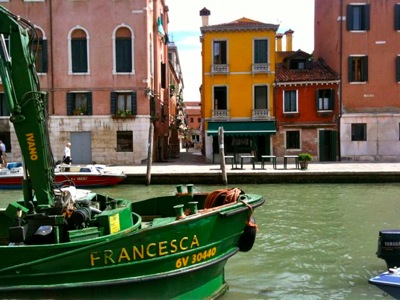 We set out pretty early on a fine morning, the water middling high in our Canale di Cannaregio, lifting the good ship Francesca nearly to sidewalk level. We were off in search of the French consulate, don't ask why, it's complicated and has nothing to do with Venice.
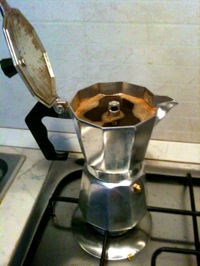 Fair enough: here's an account of today's activity, a typical day. It's a little embarrassing, because it's pretty haphazard. But that's how things go. I get up first, about eight, and pad downstairs to put the coffee and milk on the stove. F___ yawns and says Buongiorno sleepily. L. arrives a little later, after I call upstairs: De koffie is klaar!
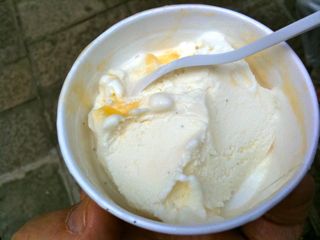 A quick sandwich and a glass of Pinot grigio at the museum café, and on to the next assignment: the ongoing assault on Venice's gelaterie. We take ice cream pretty seriously in our family; the art-and-craft of making it is as technical, complex, and privy to failure as is that of making paintings. And while we can photograph various ice creams, preserving their visual appearance quite as well as we do that of the paintings we see, we can't record their taste, smell, and texture; we can only take notes, or try to commit to memory. Rating the gelati we have tasted is therefore a fool's game: but we try. Buono, I might say, ma non ottimo; or occasionally ottimo, ma non ultimo. Now and then, though, as today, F___ and I will exchange glances over our cups — well, in fact, she almost invariably prefers cones — and simply vocalize a quiet little “hum.”
  Just before getting to VizioVirtù we ran across the Carlo Goldoni house-museum. What serendipity! (But of course that's the essence of Venice.) I'd already been attracted by the sight of a staircase behind a locked grating, and stuck my camera between the bars to try to catch it. Immediately, though, we next came to a sign and a doorway inviting us in. The large, elegantly proportioned cortile is beautifully though dimly lit: at one end, a grate over a doorway looking out onto a side canal; at the other, the staircase, open to the sky, leading up to the house on the first floor: ascending it, you realize all really Italian Italian houses begin upstairs; they're set atop stables, or cantinas, or garages, or as in this case a courtyard, empty now, but probably at one time given over to a donkey, a few barrels of wine, and a boat.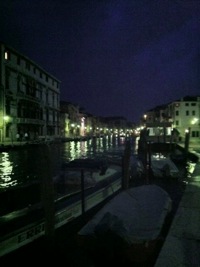
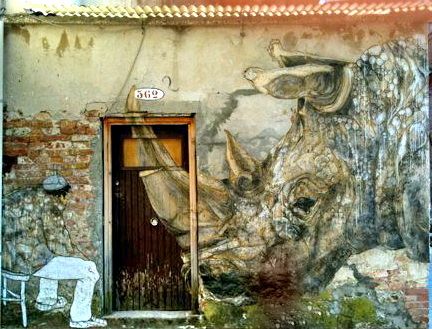

 Sources disagree, too, as to whether this miraculous thing — everyone agrees it's miraculous, in one way or another — was truly lost and luckily found, or simply moved, with the former owner's permission or not, from the next-door garden.
 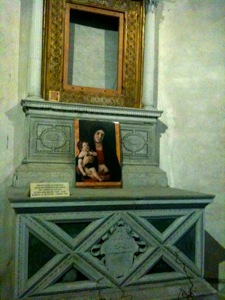 Back home I looked over the day's photos. Among them one I find rather touching: the first side chapel on the left, at Madonna dell'Orto, where a particularly beautiful Bellini should be hanging, and where there is now in fact only an empty frame. The painting was redistributed in the early 1990s, according to a label accompanying the photographic reproduction standing near the empty frame.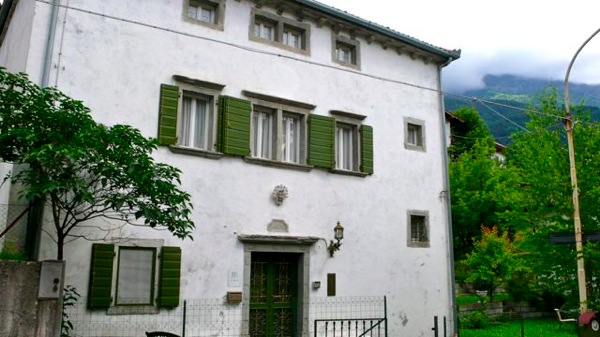
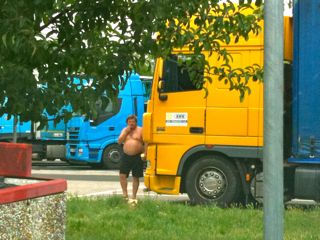
 Alas, I did not catch him at one of the times he carefully poured the steaming-hot water out of the saucepan in which he'd just cooked his pasta — he ate at least two pans full.
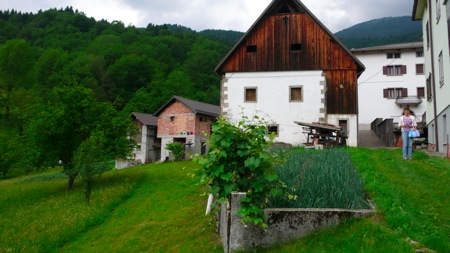
  We stopped to admire one garden, bordered by fragrant carnations and stocks but containing plenty of vegetables. Its proprietor seemed surprised we'd find it worth stopping for, explaining the flowers were there simply because she liked smelling them. It was hard to understand her Italian: the local dialect is apparently pretty forceful, elbowing schoolroom Italian out of daily conversation. It was hard to break off the conversation, partly because of that: but we continued our peregrination,
